

The hybrid work model is now firmly established, and with it comes a unique set of challenges. We're no longer tethered to a single location, but that freedom often comes at the cost of constant context switching. One minute you're responding to emails, the next you’re in a video call, and then you're trying to focus on deep work – all before lunchtime. This fragmentation of attention is exhausting, and it leaves many professionals feeling overwhelmed and depleted.
The always-on culture exacerbates the issue. Boundaries between work and personal life are increasingly blurred, leading to a sense of never truly being able to disconnect. This isn’t a matter of simply being "busy’; it"s a fundamental shift in how our brains process information and manage stress. We're asked to hold more in working memory, and to react more quickly, which takes a toll.
That’s where even a small practice like a 5-minute morning meditation can make a profound difference. It’s not about adding another task to your already full plate, but about proactively reclaiming a small pocket of time for focus and calm. It's about building a mental buffer against the demands of the day. It’s a reset button before the chaos begins, and a way to cultivate a sense of groundedness amidst the constant change.
I've seen firsthand how even the most skeptical professionals can benefit from incorporating a short meditation into their routine. The key is to make it accessible and realistic, fitting it into your life, not trying to force your life into it. Five minutes is achievable, and the benefits – improved focus, reduced stress, and increased emotional regulation – are well worth the investment.
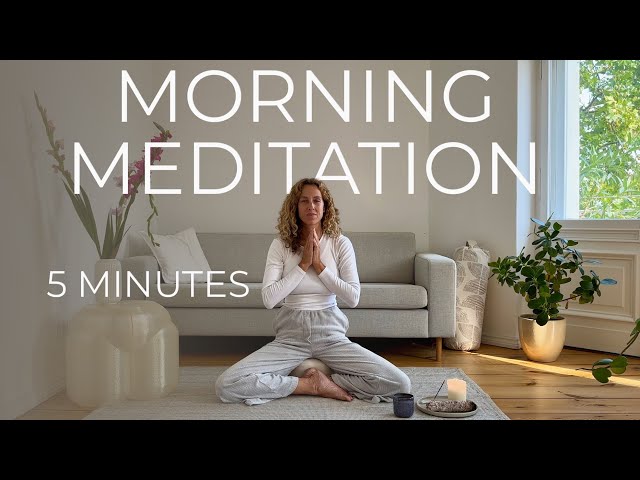
Not every morning is the same, so your meditation shouldn’t be either. Here are five 5-minute routines, each designed to address a specific type of morning you might encounter in a hybrid work schedule.
The Commute Substitute: For fully remote days, it’s easy to roll out of bed and straight into work. This routine simulates the transition of a commute. Begin with 2 minutes of focused breathing – inhale deeply for 4 seconds, hold for 4, exhale for 6. Then, spend 3 minutes visualizing your workspace, mentally preparing for the day, and setting a single intention. This helps create a psychological boundary between "home’ and ‘work".
The Quick Reset: Days packed with back-to-back meetings demand a rapid centering technique. Start with 1 minute of body scan meditation – noticing sensations in your feet, legs, torso, and head without judgment. Follow with 4 minutes of mindful listening, paying attention to the sounds around you without labeling them. This helps anchor you in the present moment and reduce reactivity.
The Energy Boost: When you need extra motivation, try a routine focused on cultivating positive energy. Begin with 2 minutes of gentle stretching, focusing on opening your chest and shoulders. Then, spend 3 minutes visualizing a successful outcome for a challenging task, focusing on the feelings of accomplishment and confidence. This activates the reward centers in your brain and boosts your motivation.
The Calm Focus: For mornings when you're facing a particularly demanding task, prioritize clarity and concentration. Start with 3 minutes of focused breathing, paying attention to the rise and fall of your abdomen. Then, spend 2 minutes visualizing a calm, still lake, allowing any distracting thoughts to drift away like clouds. This promotes a sense of mental stillness and enhances focus.
The Gratitude Start: Cultivating a positive mindset can set the tone for the entire day. Begin with 2 minutes of silent reflection, thinking about three things you’re grateful for. Then, spend 3 minutes extending that gratitude outwards, visualizing sending positive energy to loved ones, colleagues, and even strangers. This fosters a sense of connection and well-being.
These routines aren’t rigid prescriptions. Feel free to adapt them to your own preferences and needs. The goal is to find what works best for you and to make meditation a sustainable part of your daily life.
- Focused breathing: Inhale for 4, hold for 4, exhale for 6
- Mindful listening: Pay attention to sounds without labeling
- Body scan: Notice sensations without judgment
- Visualization: Create mental images to evoke specific feelings
Soundscapes and meditation apps can be incredibly helpful in facilitating these routines, especially for beginners. At Zenful State, we offer a curated collection of meditation music and sounds designed to promote relaxation and focus. Our specialized meditations cater to various needs, from sleep to stress reduction.
However, we’re not the only option. Headspace is well-known for its guided meditations and user-friendly interface. Calm provides a wide range of sleep stories and soundscapes. Insight Timer offers a vast library of free meditations from various teachers and traditions. Each app has its strengths, so it’s worth exploring to find one that resonates with you.
When using these tools, be mindful of customization. Experiment with different soundscapes – nature sounds, ambient music, binaural beats, or isochronic tones – to see what works best for your routine. Adjust the volume and duration to your liking. And, crucially, avoid getting distracted by the app itself. The goal is to use it as a tool to enhance your meditation, not as a source of stimulation.
I've found that using noise-canceling headphones can be particularly effective in minimizing distractions, especially when meditating in a noisy environment. But even without headphones, a well-chosen soundscape can create a sense of calm and tranquility.
Popular Meditation Apps: A Comparison for the Hybrid Worker (2026)
| App | Guided Meditations (5-Minute Options) | Soundscapes & Music | Offline Access | User Interface |
|---|---|---|---|---|
| Zenful State | Excellent - Wide variety, specifically tailored routines | Excellent - Extensive library, including nature sounds and ambient music | Good - Available with subscription | Good - Clean and intuitive, focused on meditation techniques |
| Headspace | Excellent - Known for beginner-friendly, short meditations | Good - Offers a selection of soundscapes and music | Good - Available for download with subscription | Excellent - Visually appealing and easy to navigate |
| Calm | Good - Includes 5-minute daily meditations and sleep stories | Excellent - Large library of music, nature sounds, and sleep stories | Good - Select content available for offline use with subscription | Good - Relaxing aesthetic, user-friendly |
| Insight Timer | Fair - Large community-created library, quality varies | Excellent - Vast collection of music and soundscapes, many free | Excellent - Extensive offline access available | Fair - Can be overwhelming due to the sheer volume of content |
Illustrative comparison based on the article research brief. Verify current pricing, limits, and product details in the official docs before relying on it.
The idea of meditation often conjures images of a quiet room and a comfortable cushion. But the reality is that life rarely unfolds in such a controlled environment. You can meditate anywhere, even in the midst of chaos.
At your desk: Take a few minutes to close your eyes and focus on your breath, noticing the sensations of your body in the chair. Ignore the surrounding noises and simply observe your thoughts without judgment.
On public transport: Use your commute as an opportunity for mindful observation. Pay attention to the sights, sounds, and smells around you without getting lost in thought. Focus on the rhythm of your breath or the feeling of your feet on the ground.
While waiting in line: Turn a mundane moment into an opportunity for mindfulness. Practice a quick body scan, noticing any tension in your muscles. Or simply focus on your breath, counting each inhale and exhale.
These "micro-meditations" – brief moments of mindfulness incorporated throughout the day – can be just as effective as a longer, more formal practice. They help you stay grounded in the present moment and reduce stress levels throughout the day.
Let’s be realistic: sticking to a meditation routine isn’t always easy. Life happens, and sometimes 5 minutes feels like an impossible luxury. Don’t beat yourself up about it. It’s okay to miss a day, or even a week. The key is to gently return to the practice when you can.
If a busy schedule is the obstacle, break down the routine into smaller chunks. Instead of trying to fit in 5 minutes at once, try three 1-minute sessions throughout the day. Or simply focus on your breath for a few moments before each meeting.
A wandering mind is a common challenge. When your thoughts drift, gently redirect your attention back to your breath or your chosen focus. Don’t judge yourself for getting distracted – it’s a natural part of the process.
Feelings of frustration are also normal. Remember that meditation isn’t about achieving a state of perfect stillness. It’s about cultivating awareness and acceptance. Practice self-compassion and remind yourself that every moment of mindfulness is a step in the right direction.
The benefits of meditation aren’t just anecdotal. A growing body of research demonstrates that meditation can have profound effects on the brain. Studies have shown that regular meditation practice can lead to changes in brain structure and function.
Brain plasticity, the brain’s ability to reorganize itself by forming new neural connections, is enhanced through meditation. This means that meditation can literally rewire your brain, strengthening pathways associated with attention, emotional regulation, and self-awareness. Research from Harvard University, led by Sara Lazar in 2000, showed that eight weeks of meditation training increased gray matter density in the hippocampus, the brain region associated with learning and memory.
Meditation has also been shown to reduce activity in the amygdala, the brain’s fear center. This can lead to a decrease in anxiety and stress. Simultaneously, it increases activity in the prefrontal cortex, the brain region responsible for higher-level cognitive functions like planning, decision-making, and impulse control.
These neurological changes translate into real-world benefits. Meditation can improve focus, reduce stress, enhance emotional regulation, and even boost creativity. It’s not just a spiritual practice; it’s a powerful tool for optimizing brain health and well-being.
While all the routines incorporate elements of these techniques, it's worth exploring diaphragmatic breathing and body scan meditation in more detail. Diaphragmatic breathing, often called 'belly breathing,' involves deeply inhaling into your abdomen, allowing your diaphragm to expand. Place one hand on your chest and the other on your stomach. As you inhale, your stomach should rise while your chest remains relatively still. This type of breathing activates the parasympathetic nervous system, promoting relaxation.
A quick body scan involves systematically bringing your attention to different parts of your body, noticing any sensations without judgment. Start with your toes, and slowly move your attention up through your feet, ankles, legs, torso, arms, and head. Notice any sensations – warmth, coolness, tingling, pressure, or pain. Simply observe these sensations without trying to change them. This practice helps you become more aware of your body and release tension.
For beginners, start with a 2-3 minute body scan, focusing on major muscle groups. As you become more comfortable, you can gradually increase the duration and pay attention to more subtle sensations. Experiment with different variations, such as focusing on areas of tension or gratitude.


No comments yet. Be the first to share your thoughts!